Apprenticing/Copy&Compose: Eileen Myles
How do you apprentice/copy & compose a piece of writing?
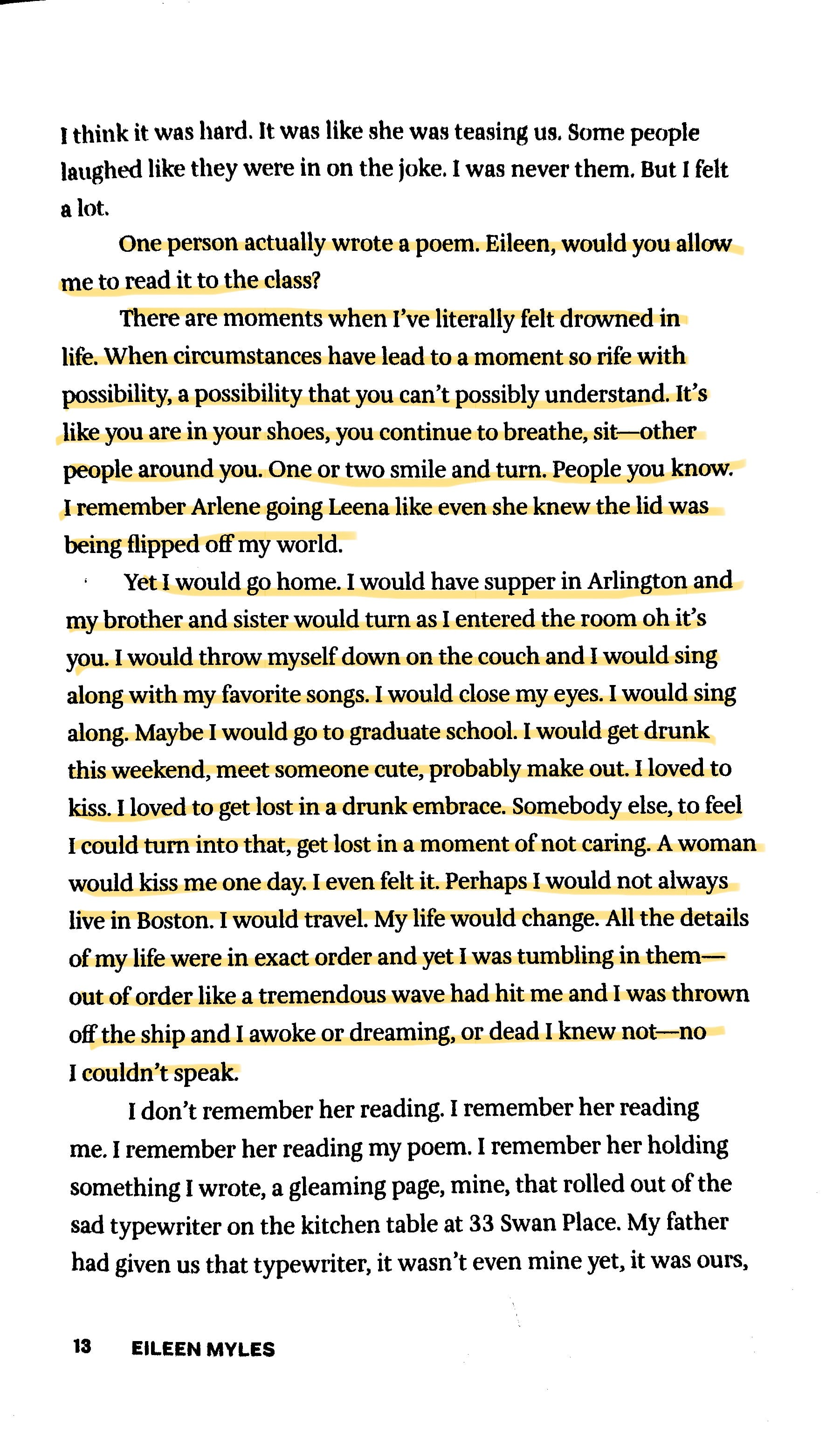
I was first introduced to the idea of apprenticing other writers in a profound and challenging writing class I took, taught by the poet Rob Halpern. I owe so much of my craft to him.
Really, I can't stress enough how much Rob's class and the things he taught so profoundly affected me. Not just in my writing, but in the way I look at basically everything. So you will hear me reference him a lot!
Because the class dipped into critical theory, semiotics, the work of Roman Jakobson, as well as the New Narrative movement, his ideas about apprenticeship were strict and rightly so.
It isn't simply getting the gist of a piece of writing and freestyling your version of it. It's getting down to the granular level and figuring out word by word, sentence by sentence, what the language is doing, then reflecting upon the writing as a whole so it can inform your own piece.
By the end, you should have an original piece of writing that closely apprentices the source. You should also have a written explication of the specific techniques and ideas that you lifted from the source and how you applied them to your own writing.
As you'll see below, I would be scolded by Rob for not apprenticing myself closely enough. But the entire point of this blog is to develop my craft, passion and consistency. So, I plan on doing this regularly and hopefully beefing up my writing muscles in the process.
A few years after that class, I found a book referenced by Chuck Palaniuk, Copy and Compose: A Guide to Prose Style by Winston Weathers and Otis Winchester published in 1969.
This is a fantastic book that breaks down prose style at the sentence level, up to the paragraph. It does so through literary examples.
Here's a page from Copy and Compose:
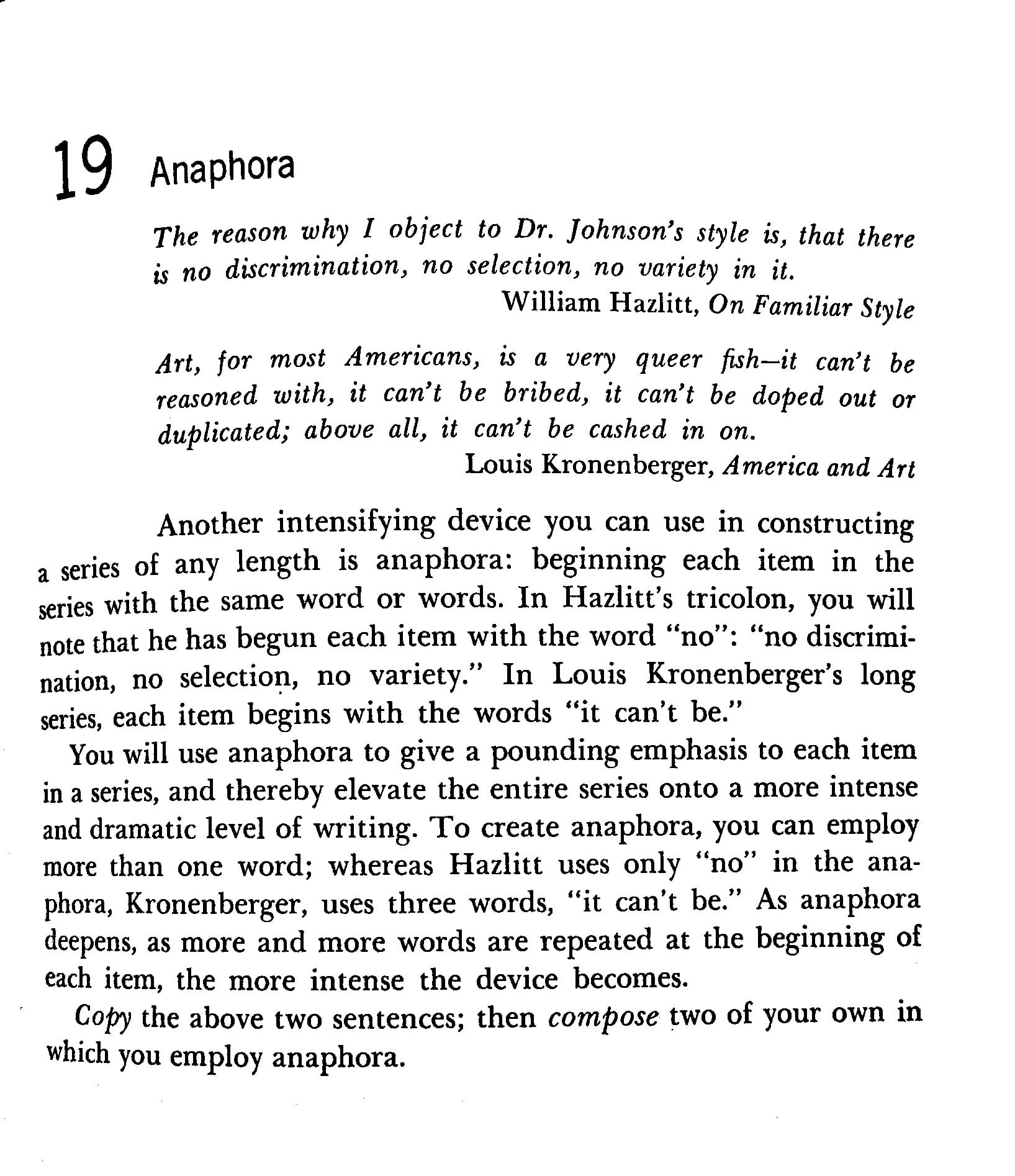
If you reread the Eileen Myles paragraph, you might notice her anaphoric use of the phrase I Would.
Also, notice the homework at the end of each page.
Copy the above two sentences. Meaning, write them down, word for word, in your notebook. You will notice that doing so gives you a sense of the writer's rhythm.
Famously, Joan Didion and Hunter S. Thompson both taught themselves how to write by copying passages from The Great Gatsby.
It's a fantastic way to feel a piece of writing.
Then, of course, Compose.
Where Rob's ideas about Apprenticeship and Copy & Compose diverge is that Weathers and Winchester explicate the idea being explored for you. For Rob, it was imperative to mine the passages and explicate them yourself, all while sticking as close to the language of the text as you can.
I personally find that Rob was absolutely right. However, when I'm being lazy, I will just copy and compose.
Below is my copy and compose of the above Eileen Myles passage.
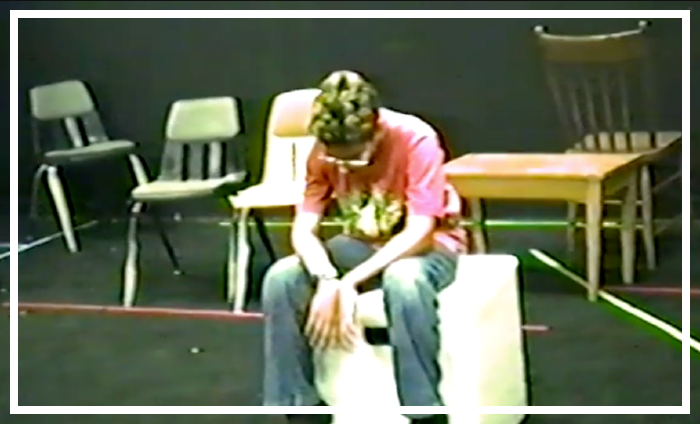
Greg can do the worm! Okay, show us your worm.
Most of kidhood’s social arenas were filtered through a gauzy shade of shame. Where desire stupidly reached out to place hands directly on other kids' perceptions of me, desire averting its eyes while wagging its tail. It’s like cool clothes bought at the mall, liberty spikes, you smirk—some kids cared. One or two popular enough to impress. The cutest girl in class. I don’t remember Davey even knowing how much I needed his approval.
Yet I would go home. I would watch Total Request Live, then Maury, then the Simpsons, then the Simpsons, then Monday night Raw or Thursday night Smackdown. I would reheat leftovers, dry chicken, chili, curling pizza slices. No one would come home and then they would. I would lay in front of the tv. I would lay my head on the sleeping dog like a pillow. I would watch TV families. Maybe I’d have my own family someday. I would get my mom to drop me off at the movies on Friday night, sneak into an R-rated flick, make prank phone calls on the payphone, flirt with girls. I loved girls forever. I loved to get them to smile. To find one audience, narrow my awareness, feel like a spotlight blacking out all others, get lost in losing myself. Women will stop smiling at me someday. I never felt that palpably. One day maybe, in Los Angeles. My mirror image. All the lines on my face and yet still I’m a kid doing the worm—wriggling about, the dust of young desire settled in the cracks still averting its eyes, looking for recognition and I cracked or clung, or gnawed my smile—no I vacated desire.
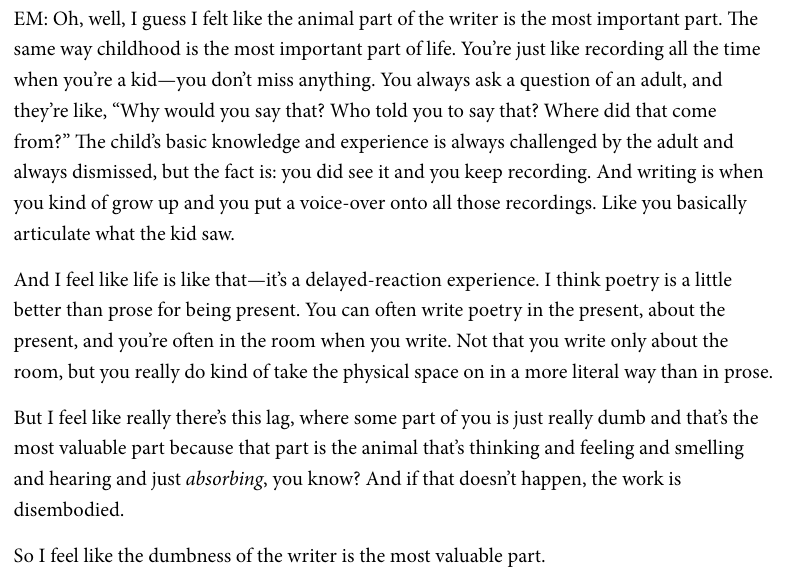
Here's an interview from The Believer that shines additional light on Eileen's ideas about writing, which I think helps inform the above piece. I also think they will be a great guide moving forward.
Overall, I think my piece fails.
There just isn't enough animal part of me in it. I also didn't apprentice closely enough. I haven't really interrogated the text and explicated my findings.
For example, the source text by Eileen is very well structured. There is a topic sentence of sorts. The next paragraph dives into a specific idea/sensation. The last big paragraph enacts that idea/sensation.
You'll also notice that as the enacting paragraph reaches a climax, where she feels "like a tremendous wave had hit me", the sentence itself breaks down and begins to mirror the disorientation that she is evoking.
Some formal features she employs are: Anaphora, as well as a lack of dialogue attribution, which creates ambiguity.
My piece is lazy.
It doesn't really factor in any of that. There doesn't seem to be much of a connection between sentences and paragraphs.
vacated desire isn't earned.
What does that even mean? It's still too abstract.
still I'm a kid doing the worm is the best line.
But that's okay. The whole point of this blog is to fail upward. To stay consistent and improve a little each time.
This was a good start. I'm excited for the journey ahead.