Massaging the Text: Camille Roy 'Experimentalism'
Massaging the Text
This is another technique I learned from Rob Halpern's class. It's definitely a foundational tool you want in your writer's toolbox.
The essay we will massage today is Experimentalism by Camille Roy. It's included in the book of essays, Biting the Error: Writers Explore Narrative, edited by Mary Burger, Robert Glück, Camille Roy and Gail Scott. It functioned as a textbook in Rob's class. He has an essay in the book himself. I highly recommend you pick up a copy.
How does one Massage a text?
Dense text can feel concentrated and, at times, inscrutable. To loosen up some of that meaning, massaging the text in small increments of information can help us figure out just what might be hidden in such hefty prose.
Now, it's important to differentiate interpreting from massaging.
We aren't straying too far from the language of the text. We aren't trying to remove it from its context just so we can elucidate it in some new realm that we are more familiar with.
We are using the text to better understand the text.
Does that make sense? Let's dive in, and hopefully it will become apparent.
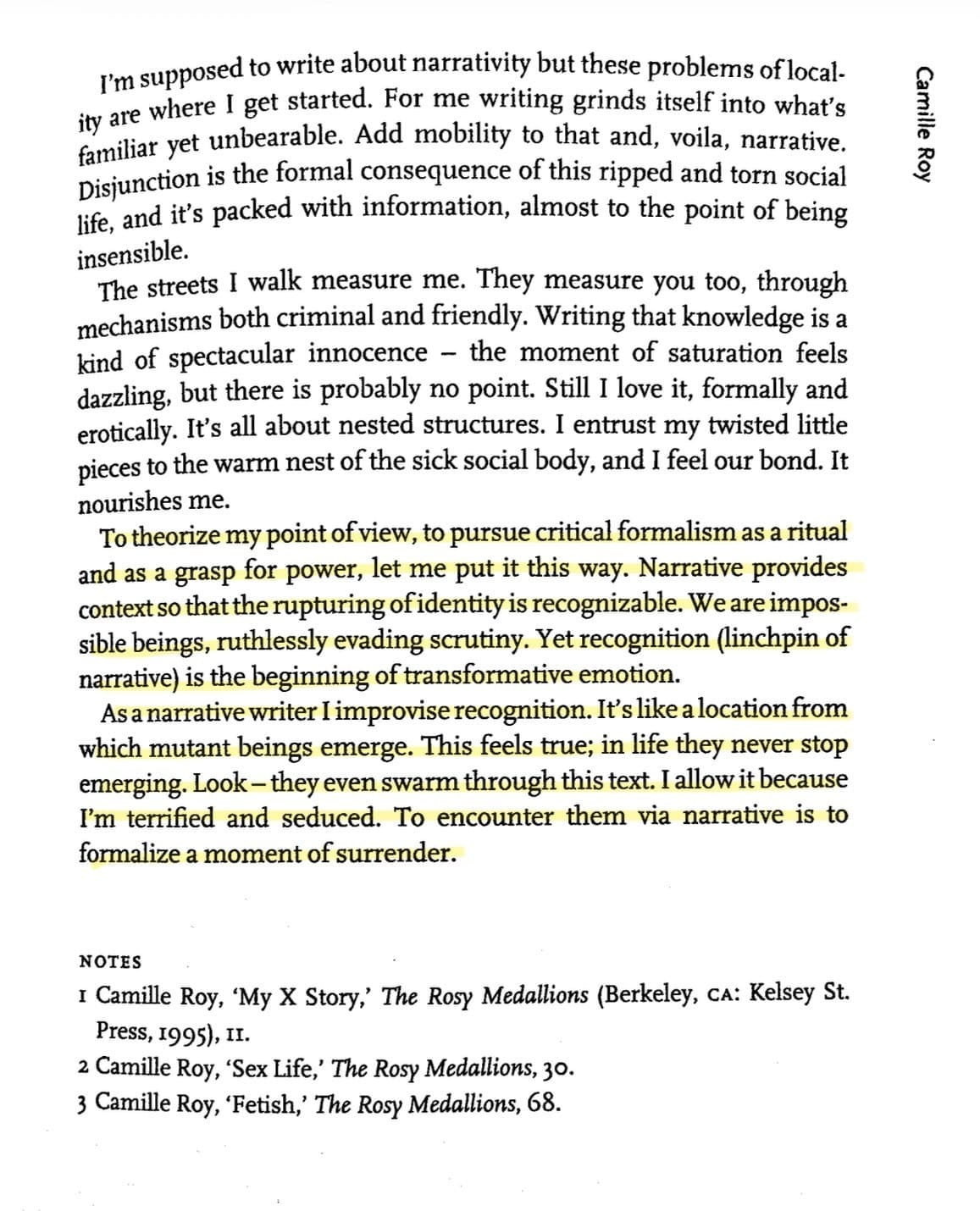
"To theorize my point of view, to pursue critical formalism as a ritual and as a grasp for power, let me put it this way."
To theorize my point of view
to fully break down and scrutinize an individual’s personal subjective experience…
to pursue critical formalism
critical formalism, critical like critical theory, but formalism, so exclusively the structure or form, the interiority of a work, devoid of outside influence or context...
as a ritual
ritual is more than just a habit or continuous undertaking, it has higher, almost spiritual connotations, also it is ordering and can be communal…
and as a grasp for power
how does pursuing the structure and interiority of a subjective experience operate as a grasp for power? I guess it removes the individual from context, from all outside influences. If ritual can create order, grasping power is a means of control...
To theorize my point of view, to pursue critical formalism as a ritual and grasp for power,
to structure a comprehensive framework for an individual subjective experience, focusing solely on the form, the interiority of the experience, excluding all outside influence and to do so as an almost spiritual or communal way of creating order and controlling all context…
Narrative provides context so that the rupturing of identity is recognizable.
a structured account of connected events provides the context, it creates the recognizable form…
the rupturing of identity
bursting of who you tell yourself you are, sudden major disturbance of personality
is recognizable
encounterable, able to be known.
Narrative provides context
if critical formalism is a way of controlling context and narrative provides that context…
the rupturing of identity is recognizable.
then the only way of encountering or being able to know the sudden bursting apart of who you think you are, your personality, is through narrative context
We are impossible beings, ruthlessly evading scrutiny
(This one is tough, it relies so heavily on its antecedent.)
Impossible beings: our identities, who we think we are, constantly contradicting, shifting and changing,
ruthlessly evading scrutiny
like cognitive dissonance. we make perfect sense to ourselves but any outside information however innocuous is a threat to the paradox of who we think we are, to our Impossible Being
Yet recognition
the knowledge that occupies the structure that can necessitate an encounter
(linchpin of narrative)
what holds it all together, vital
knowledge that necessitates an encounter is what holds together the contextual structure that is narrative
is the beginning of transformative emotion.
it offers the way into transformative emotion, emotion that causes a fundamental change in form, like identity, the crack that enables the rupture of identity, the sudden bursting apart of who you think you are.
(But remember we don’t want this, we are Impossible Beings ruthlessly evading scrutiny.)
What do we have so far?
To structure a comprehensive framework for an individual subjective experience, focusing solely on the form (the interiority of the experience, excluding all outside influence) and doing so in an almost spiritual or communal way of creating order and controlling all context. If critical formalism is a way of controlling context and narrative provides that context, then the only way of encountering or being able to know the sudden bursting apart of who you think you are, your personality, is through narrative context. Our identities ('Impossible Beings'), who we think we are, are constantly contradicting, shifting and changing, like cognitive dissonance. We make perfect sense to ourselves but any outside information however innocuous is a threat to the paradox of who we think we are, to our 'Impossible Being'. The vital knowledge that occupies the structure that can necessitate an encounter is what holds together the contextual structure that is narrative. It offers the way into transformative emotion, emotion that causes a fundamental change in form, like identity. It's the crack that enables the rupture of identity, the sudden bursting apart of who you think you are. But remember we don’t want this, we are 'Impossible Beings' ruthlessly evading scrutiny.
As a narrative writer I improvise recognition.
As a writer that works within the formal structure that controls context, I free associate and play with the knowledge that occupies the structure that can necessitate an encounter.
It’s like a location from which mutant beings emerge.
It’s: transformative emotion. Emotion (recognition) that causes a fundamental change in form, like identity, the crack that enables the rupture of identity, the sudden bursting apart of who you think you are.
Mutant beings emerge
the parts of ourselves we reject and don’t allow into our 'Impossible Beings', the scrutiny we ruthlessly evade
This feels true; in life they never stop emerging.
we feel emotions, this is her personal subjective confirmation of recognition. It has happened to her, she can empirically confirm,
in life they never stop emerging
the parts of ourselves we ruthlessly evade, they never stop encountering transformative emotions that fundamentally alter our form, bursting apart who we think we are.
Look—they even swarm through this text.
she speaking of the anecdotes and excerpts from her work in this essay that created locations from which mutant beings emerge.
I allow it because I’m terrified and seduced.
arousal and desire are powerful, fictive terror and seduction are safe spaces to encounter danger, danger both to bodily and psychological harm and total ego loss in the deconstruction of the sexual identity and the reduction of self to object. we invite these things in.
I allow it
so do we as readers, we invite these mutant beings in, we are terrified and seduced
To encounter them via narrative
to encounter these transformative emotions, the crack that allows the bursting apart of identity, locations from which mutants emerge, via a formal structure that controls context
is to formalize a moment of surrender
to create the necessary structure or form that holds the nexus of transformative emotion, where we willingly allow who we think we are to burst apart.
What do we have so far?
As a writer that works within the formal structure that controls context, I free associate and play with the knowledge that occupies the structure that can necessitate an encounter. Transformative emotion, emotion (recognition) that causes a fundamental change in form, like identity, is the crack that enables the rupture of identity, the sudden bursting apart of who you think you are. The parts of ourselves we reject and don’t allow into our impossible beings, the scrutiny we ruthlessly evade. The personal subjective confirmation of recognition has happened to her, she can empirically confirm that the parts of ourselves we ruthlessly evade, they never stop encountering transformative emotions that fundamentally alter our form, bursting apart who we think we are. The anecdotes and excerpts from her work in this essay created locations from which mutant beings emerged. Arousal and desire are powerful, fictive terror and seduction are safe spaces to encounter danger, danger both to bodily and psychological harm and total ego loss in the deconstruction of the sexual identity and the reduction of self to object. We invite these things in (or rather we invite them to emerge from out of us). We as readers, we invite these mutant beings in. We are terrified and seduced to encounter these transformative emotions, these cracks that allow the bursting apart of identity, these locations from which mutants emerge, is done via a formal structure that controls context to create the necessary structure or form that holds the nexus of transformative emotion, where we willingly allow who we think we are to burst apart.
All together now:
To structure a comprehensive framework for an individual subjective experience, focusing solely on the form (the interiority of the experience, excluding all outside influence) and doing so as an almost spiritual or communal way of creating order and controlling all context. If critical formalism is a way of controlling context and narrative provides that context, then the only way of encountering or being able to know the sudden bursting apart of who you think you are, your personality, is through narrative context. Our identities ('Impossible beings'), who we think we are, are constantly contradicting, shifting and changing, like cognitive dissonance. We make perfect sense to ourselves but any outside information however innocuous is a threat to the paradox of who we think we are, to our 'Impossible Being'. The vital knowledge that occupies the structure that can necessitate an encounter is what holds together the contextual structure that is narrative. It offers the way into transformative emotion, emotion that causes a fundamental change in form, like identity. It's the crack that enables the rupture of identity, the sudden bursting apart of who you think you are. But remember we don’t want this, we are 'Impossible Beings' ruthlessly evading scrutiny.
As a writer that works within the formal structure that controls context, I free associate and play with the knowledge that occupies the structure that can necessitate an encounter. Transformative emotion, emotion (recognition) that causes a fundamental change in form, like identity, is the crack that enables the rupture of identity, the sudden bursting apart of who you think you are. The parts of ourselves we reject and don’t allow into our impossible beings, the scrutiny we ruthlessly evade. The personal subjective confirmation of recognition has happened to her, she can empirically confirm that the parts of ourselves we ruthlessly evade, they never stop encountering transformative emotions that fundamentally alter our form, bursting apart who we think we are. The anecdotes and excerpts from her work in this essay created locations from which mutant beings emerged. Arousal and desire are powerful, fictive terror and seduction are safe spaces to encounter danger, danger both to bodily and psychological harm and total ego loss in the deconstruction of the sexual identity and the reduction of self to object. We invite these things in (or rather we invite them to emerge from out of us). We as readers, we invite these mutant beings in. We are terrified and seduced to encounter these transformative emotions, these cracks that allow the bursting apart of identity, these locations from which mutants emerge, is done via a formal structure that controls context to create the necessary structure or form that holds the nexus of transformative emotion, where we willingly allow who we think we are to burst apart.
Okay, take a breath.
Honestly, after massaging these two paragraphs. I definitely have a better understanding of what she is pointing at. But I'm not gonna kid you. I don't fully understand what she's saying.
I do have feelings and associations that make me excited to write.
Besides, anyone who waits until they fully understand a craft before beginning never has a damn thing to show for themselves.
In last post, we spoke of Rob's idea of apprenticing a piece of writing, carefully studying, then lifting ideas and techniques from it to inform an original piece of writing.
So what have we learned? And how might that inform an original piece?
Homework:
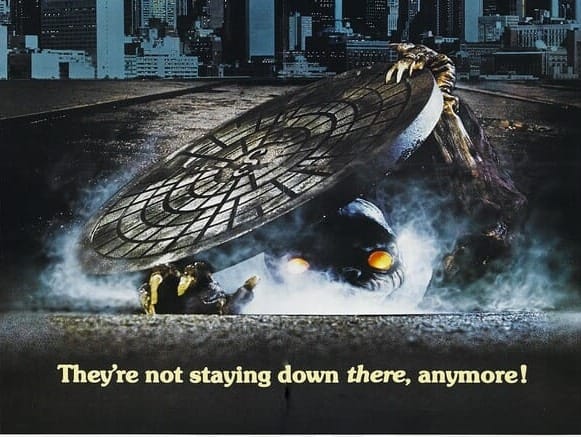
Using the text as a guide, write a short narrative piece that actively and pointedly utilizes genre to create 'a location from which mutant beings emerge.'
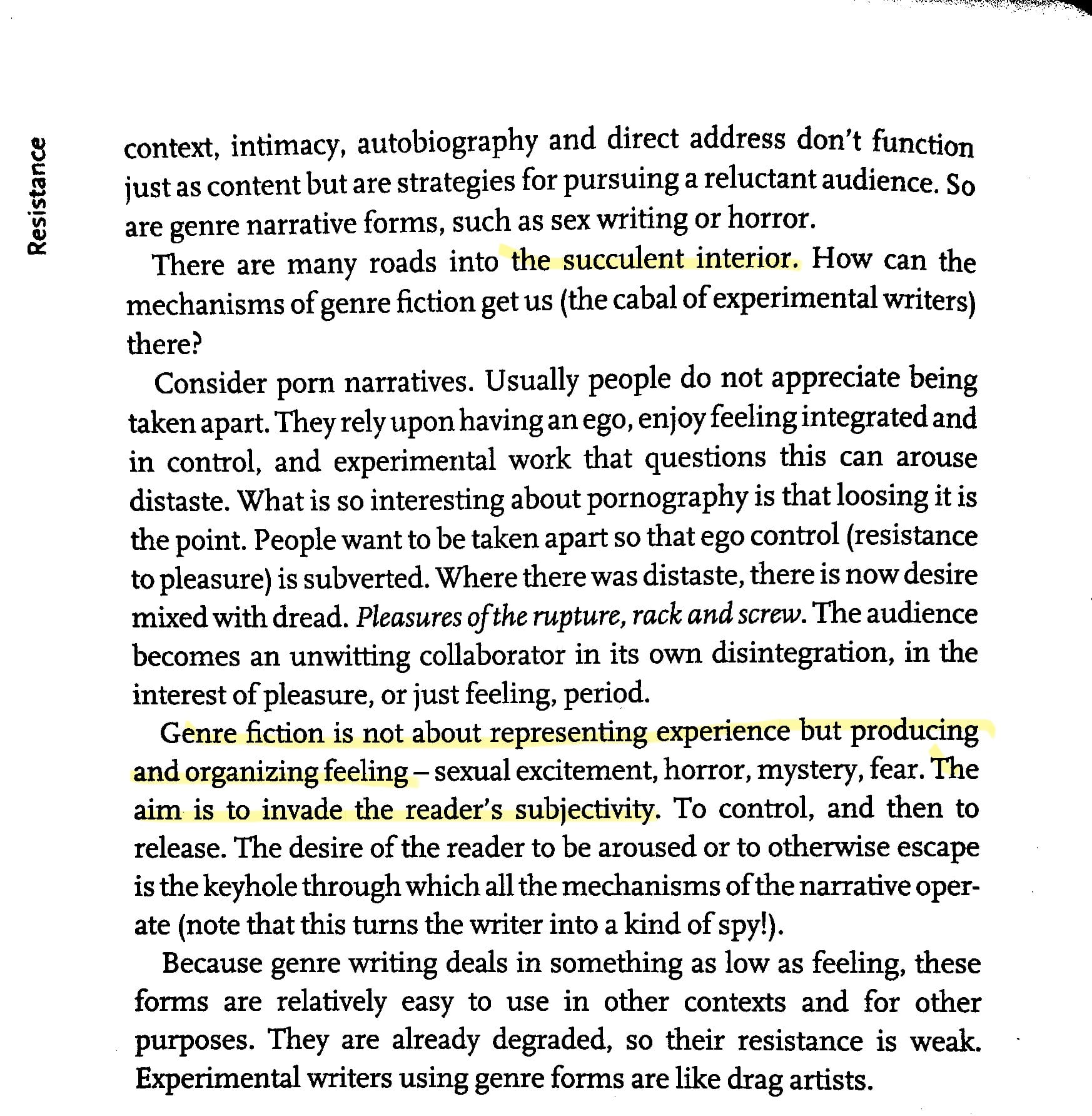
We'll need to chew on these ideas a bit more before we compose our own original piece.
Next post, we'll dive a little deeper as we prepare to write a short narrative piece of our own.