The Succulent Interior: Interrogating Horror
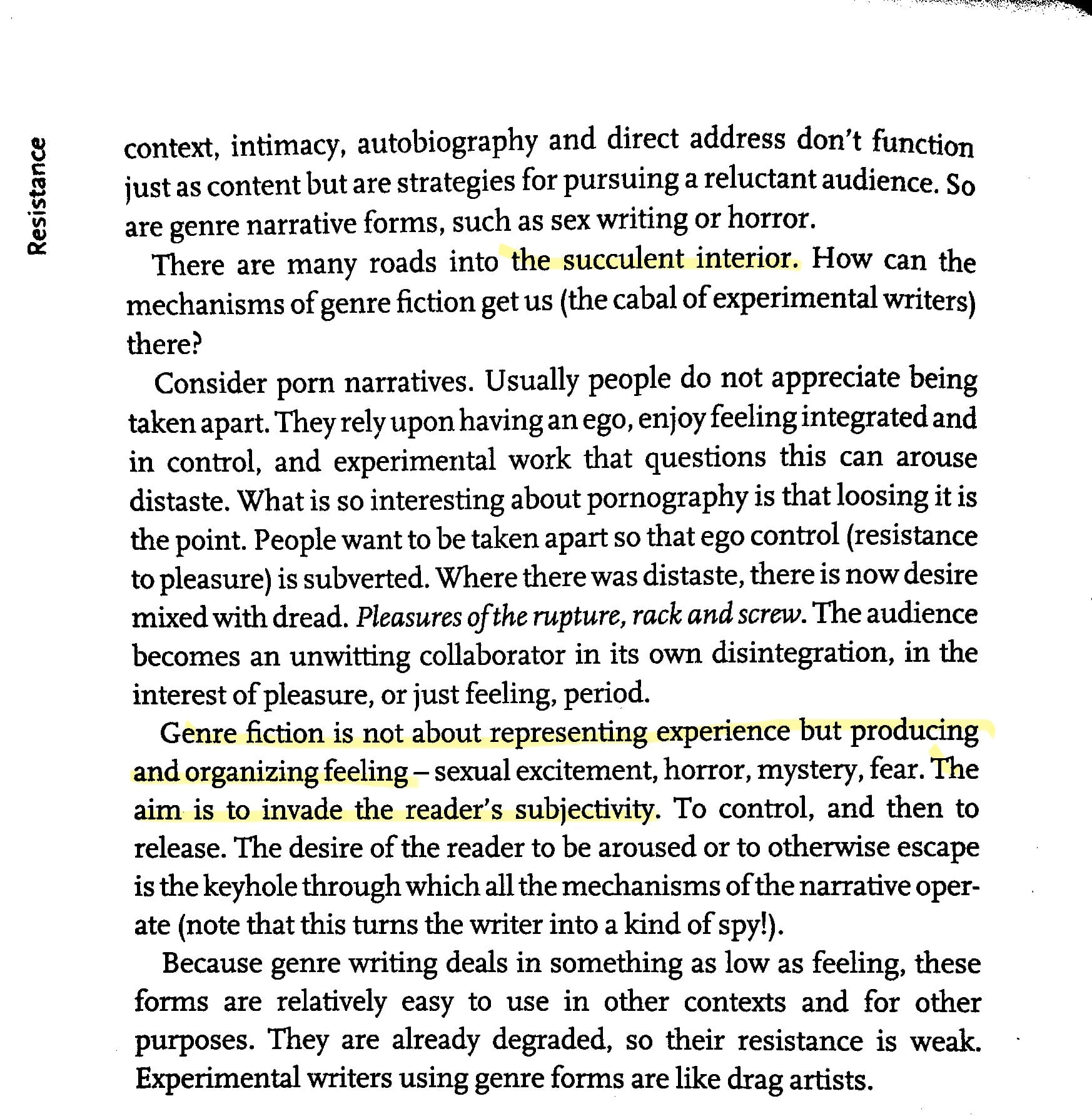
"There are many roads into the Succulent Interior."
Hoowee! What a sentence!
Based on the last posts' massaging of the text*, my best guess as to what the Succulent Interior is pointing at is…
The vast playground inside your Impossible Being. The place where mutant beings emerge from.
*note: many of the terms used in this post are well defined in the previous post.
She even gives us a roadmap:
The Mechanisms of Genre Fiction.
So what are these mechanisms?
Plot is probably the most obvious. Many people who enjoy Horror and SciFi and Fantasy don’t fully get the point of Literary fiction. They often call it plotless. And I think much of literary fiction is plotless because those kinds of writers are suspicious of plot. It feels too heavy-handed. It also becomes easy prey to societal conventions. This is what Roy states in her essay. (Narrative is often guilty of Middle Distance and Naive Realism. These are two terms I learned in Rob Halpern's class. We will dive deeper into them a little later in this post.)
We’re all familiar with plot.
Porno: I bought a pizza, but I have no money. Is there another way I can pay?
Horror: Me and my buddies are gonna stay in a cabin in the woods. What’s the worst that could happen?
Scifi: Society has collapsed, and a new post-apocalyptic wasteland must be navigated.
Fantasy: A magical talisman is in the hands of Evil. A ragtag team of misfits must save the world by stealing it.
Okay, what else? What are some other mechanisms?
To be honest, I’m not entirely sure. I would guess that all of the endlessly catalogued tropes would fall under genre mechanisms.
Let’s go back to the text to see if Camille offers other clues.
Genre fiction is not about representing experience but producing and organizing feeling—sexual excitement, horror, mystery, fear.
I think the word organising is very important. Another word could be controlling. Genre is trying to create and control feeling.
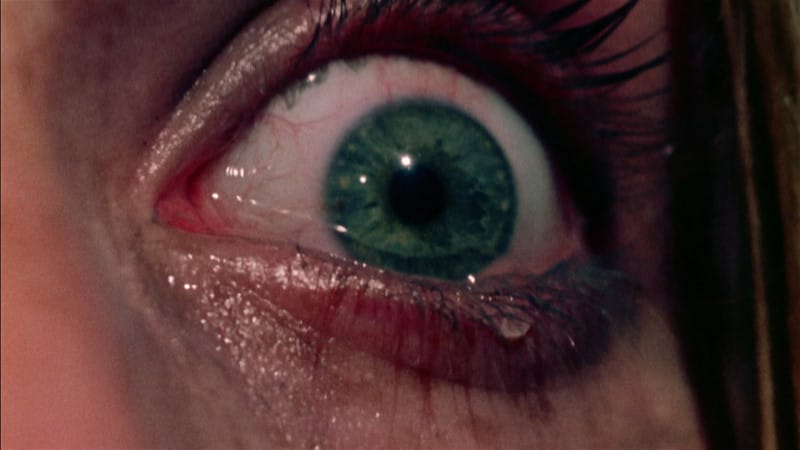
The Texas Chainsaw Massacre is trying to create and control horror.
It’s a great example. That movie has no interest in representing the experience of some University of Austin students' road trip. Where are they going? To visit their family’s grave. They do that within the first 10 minutes of the movie. Then what? Who cares? Terror ensues.
TCM is only interested in manipulating your feelings. The sound design. That disgusting, squirming screech that plays over the opening credits and returns again and again to produce and organise our feelings of disgust and dread. The uncomfortable close-ups of disturbing images that flash like a crime-scene photo to produce and organise our feelings. The fully sunbaked, lived-in, oppressively sweaty and isolated world of “South Texas”.
The aim isn’t to represent experience.
The aim is to invade the reader’s subjectivity.
TCM is producing and organising feeling to invade your subjectivity.
Now, it is probably one of the most deconstructed horror films in history. Far be it from me to add anything of substance to the conversation.
But I think it would be a worthy undertaking to try and find some of the Mechanisms for ourselves.
So let’s pop in a tape and take some notes…
Here’s my advice for how to approach this exercise:
Transformative emotion has its own language.
We want to avoid Middle Distance: language that is far enough away to still be recognisable but not close enough to be specific. It's a safe distance, that generalises perspective, as if we are all the same.
We want to avoid Naive Realism: the idea that words exactly describe the things in the world they are pointing towards. That the word love exactly captures that unique, indescribable experience. If you are writing a horror story and you use the description, “It was like something out of a horror movie,” you deserve a spanking.
So try to get up close. Try to speak from an emotional level. Try to experiment with words. As Rob would constantly tell us,
Risk nonsense for new sense.
Most importantly, have fun!
Writing should be fun. No one but you will read this. There is no right and wrong unless you get lazy and fall back into Middle Distance and Naive Realism.
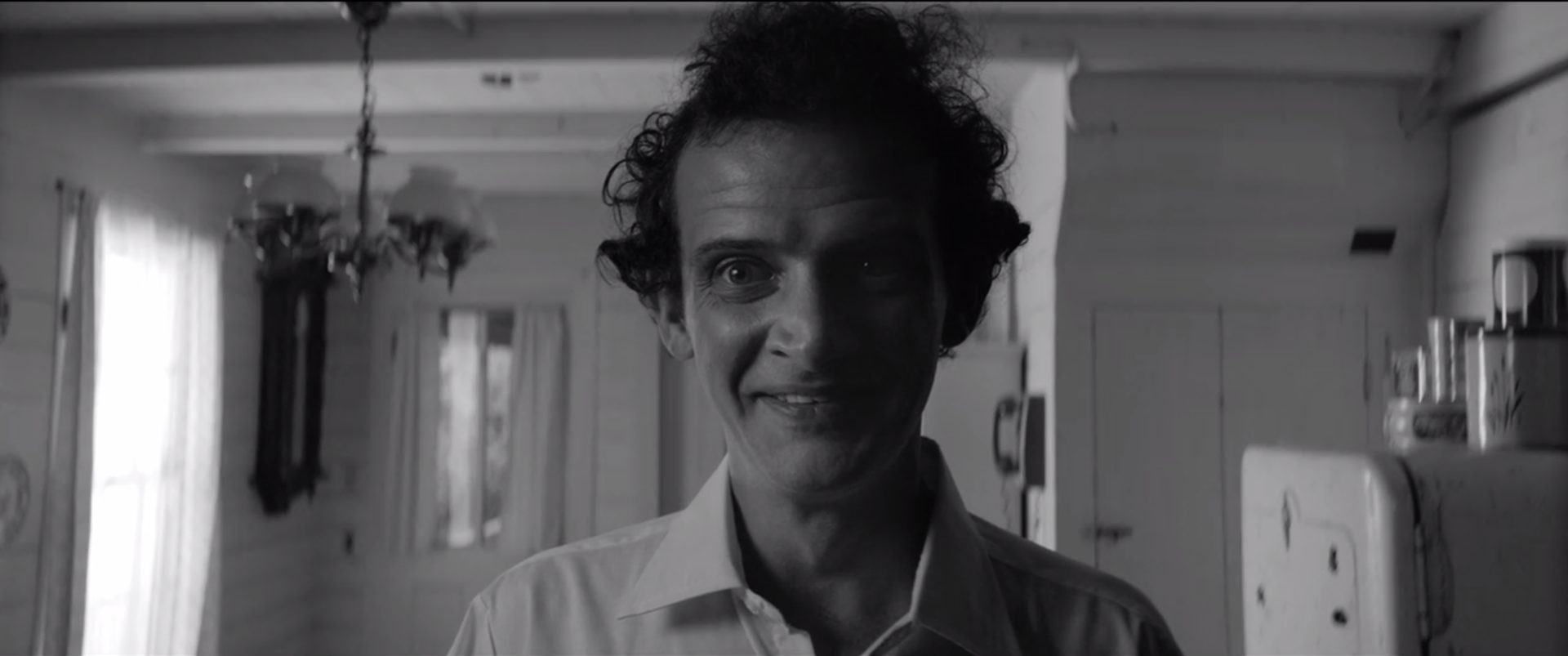
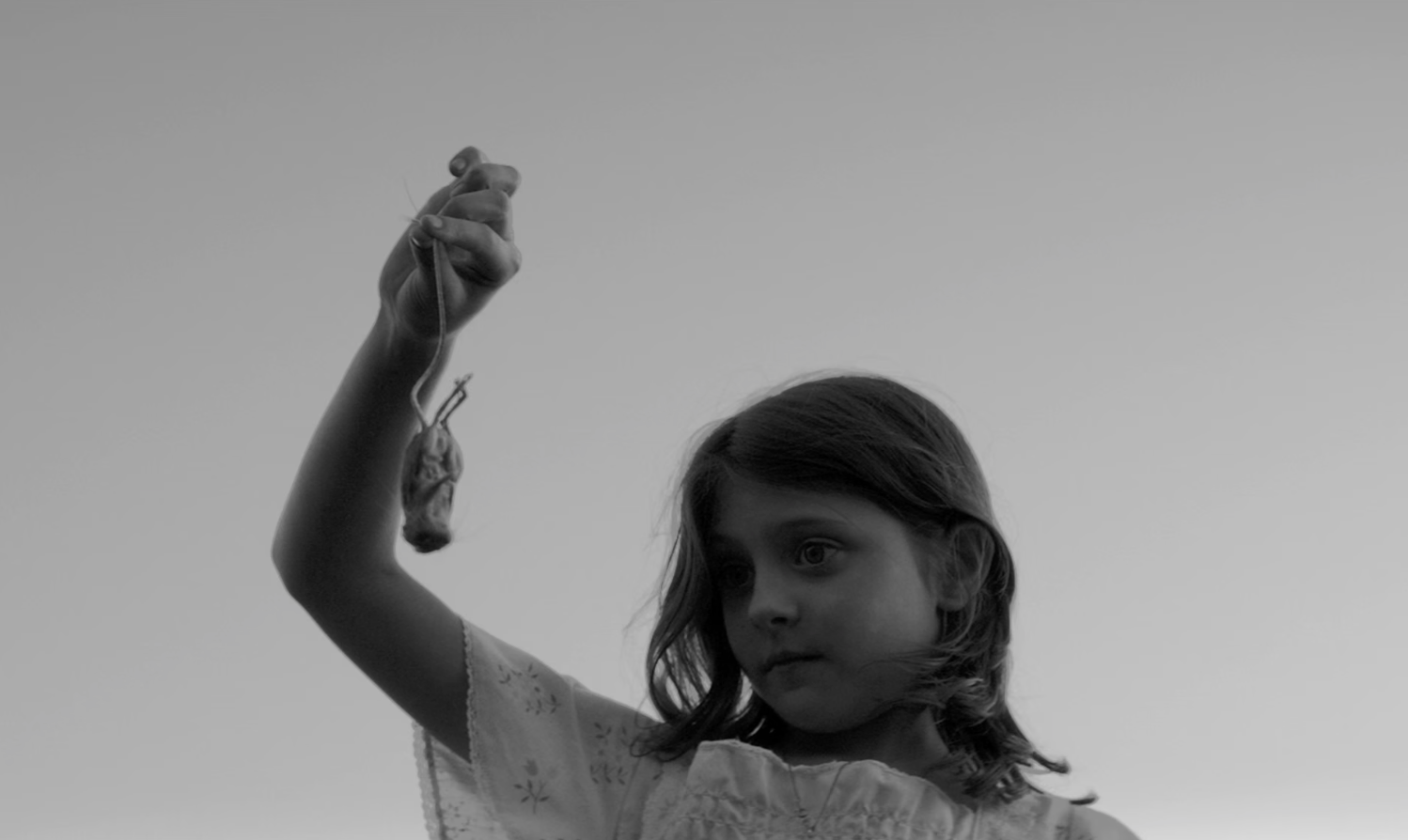
Interrogating: The Eyes of My Mother
The bathroom is through the living room to the right.
Will you show me?
an upward intonation. A warm smile. A friendly wave. A light handshake. His smile rushes the frame. His wave overshadows the subject. The handshake won’t let go. Closer.
I think you should show me.
a decapitated snake writhing in death spasm. An ant under a magnifying glass. Tsss. Tssss.
Embalmed objects ornament the outer edges. Her daughter's head, a shrivelled raisin at the bottom of the frame. The woman, left alone in space to grind her teeth.
The man, left alone in space to press his fangs through the bars.
Ma’am, I’m trying to be polite.
take a breath, there’s inevitability dangling between us.
We can try this one more time before I start to become unreasonable.
what about my child?
how many steps through the living room to the right? how slow can I walk? How many slow steps until my husband comes home?
I’m going to find something that has never before hardened under my scrutiny and climbed on my back in that bathroom, through the living room to the right.
Do you want something to eat, Daddy?
Scrubbing sounds and tobacco crackles, circular blood smears in black and white.
Daddy, dirty, sits on the edge of the bed.
I need help with your mother.
backlit. one spotlight in the night always illuminates more than is desirable
the tacky coagulated bedsheet, the blasted, almost translucent flesh huffing and grunting, the brow bracing towards pragmatism and away from blunt force trauma.
so much depends upon the little red wheelbarrow.
you need to take care of this
Fran fran fran Franny franny
wipe my hands and close the barn
why are you laughing
it feels amazing
a tongue and two eyes in the refrigerator
he won’t make anymore noise
It’s a first draft. It’s not perfect.
It’s not good. But that’s not the point. We are just playing. We are looking for something. We are risking nonsense for new sense.
Shit, we are risking cringe for transformative emotion.
But what it does do is point to something…
The scene begins innocuously. A door-to-door salesman asks to use the bathroom. The woman is alone at home with her child.
There are unspoken social rules that this interaction must glide upon.
The bathroom is through the living room to the right.
Easy enough. But then the man says,
Will you show me?
Something is happening that she doesn't want to happen. So she says,
The bathroom is through the living room to the right.
This is her talisman against the unknown. If she sticks to the script. So will he. Right?
I think you should show me.
The social rules are cracking. They no longer glide. They are going off the rails.
The centrally framed subjects in this sequence do a lot to invade our subjectivity. The woman is alone in the frame, nothing but empty space on all sides, and nowhere to go. Her child is pushed protectively behind her. She is alone.
The man is centrally framed, but he has mobility. He approaches the camera, oppressively filling the frame.
Ma’am, I’m trying to be polite.
With the social rules off the rails, where are we going?
We can try this one more time before I start to become unreasonable.
I think we all remember a moment in our lives when a normal interaction suddenly lost its guardrails. Where we entered a no man’s land. Where we floated in space, in anticipation. Our emotions alienating us from our everyday delusions. Delusions that there is order and safety in every moment.
I think this is a moment for transformative emotion. I think this is a mechanism!
But I’m not filmmaking. I don’t have an image to manipulate. I don’t have sound. I just have words.
Do I think that my little writing exercise captured Transformative Emotion? No. But it got me thinking and playing in a new sandbox. It built up some nonsense/newsense muscles.
Let’s take a step back.
I don’t want us to forget our Animals.
Remember Eileen Myles. This isn’t a top-down construction. I know we are talking about Formalism. We are discussing structure. But here is my suggestion for an approach:
Take a couple of these mechanisms, the ones that speak to you and let them stir up some feelings and associations. Let them inspire certain concrete images, sequences, situations, etc. Make a running experiential list.
Then pick one and begin writing.
Begin exploring the inspired idea, the way you would map out a room blindly in the dark. Bump into objects, lean into uncertainty, maintain specificity in isolation.
In other words: play.
If you get stuck, jump to the next inspired idea.
Do this until you have enough written down, and a story emerges. Then you can start some manipulation. You can start leaning into mechanisms. You can impose narrative structure.
But remember, we are trying to control Narrative, to exploit Transformative Emotion.
And why are we doing that? Because we feel, damn it!
We feel so god damn much. All the time.
We are writing because so much of who we think we are is mediated by narrative structures: social norms, social media, etc. We sloppily exist outside of the frame of these narrative structures. Sure, we exist within them as well, but that’s just a fraction. If we want to return ourselves to ourselves, we have to leave the frame. We have to try to go where words can’t easily go. We have to try to stretch the boundaries of language. We have to, as Rob says, risk nonsense for new sense.
And in writing like that, you might just transform yourself.
Doesn’t that sound nice?
Homework:
Watch a horror movie and take notes on moments of ‘Invaded Subjectivity’. Then use what you learn to begin drafting a short narrative piece.
Keep these two things in mind while doing so:
Genre fiction is not about representing experience but producing and organising feeling.
The most valuable part… is the animal that’s thinking and feeling and smelling and hearing and just absorbing, you know?
(Also, avoid Middle Distance and Naive Realism!!!)
Perhaps another clue towards capturing the sensory details of Invaded Subjectivity lies in Ekphrasis.
Explore Ekphrasis here:
https://www.poetryfoundation.org/education/glossary/ekphrasisthe